A Searchable Database for Life Decisions, With Citations
HowToLiveBetter fills a gap in personal decision-making: a structured, searchable reference where every recommendation includes explicit costs, benefits, evidence grades, and citations. Built as static HTML with zero dependencies, it's designed to be forked into WeChat mini-programs, Android apps, and multilingual editions—and developers are doing exactly that.
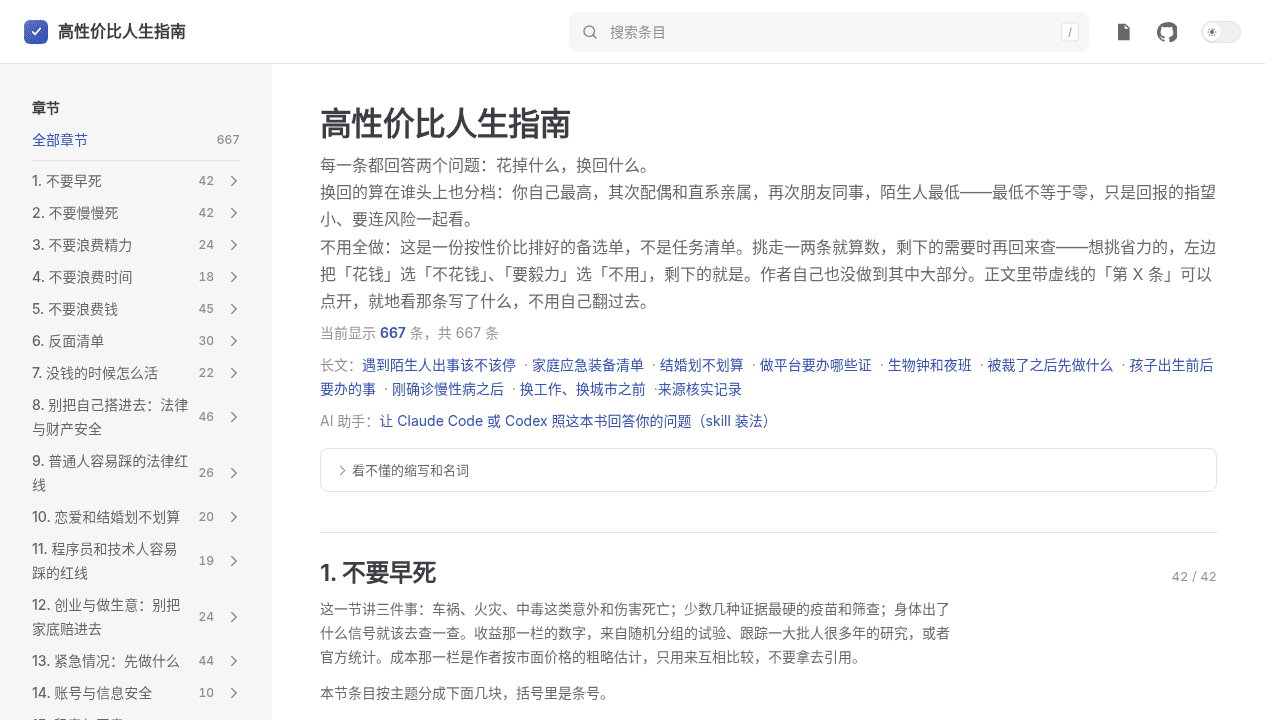
Most health advice tells you to exercise more. This repository tells you that moderate aerobic activity costs 150 minutes per week, reduces cardiovascular disease risk by 30%, carries an evidence grade of A, and cites a peer-reviewed meta-analysis. That structured approach—explicit costs, quantified benefits, evidence grading, and source attribution for every recommendation—is what makes HowToLiveBetter different from typical self-help content.
The gap: no searchable, cited, cost-aware life guidance
Information about health, finance, and legal matters exists, but it's scattered across medical journals, government websites, and advice columns that rarely show their work. For Chinese-language audiences, the accessibility gap is wider: English-language resources dominate, and localized guidance often lacks systematic sourcing. HowToLiveBetter addresses this by covering health, finance, legal, employment, family, and emergency topics in a searchable reference where each recommendation breaks down costs versus benefits and links to official documents or academic studies.
What makes this a decision-support database, not self-help
The format is closer to a structured data corpus than a blog. Each entry includes cost dimensions (time, money, effort), benefit categories (health outcomes, financial impact, risk reduction), evidence grades assigned based on study quality, and citations to source material. A recommendation about vitamin D supplementation lists daily dosage costs, expected serum level changes, and links to randomized controlled trials—not anecdotes or testimonials. The interface is spare: a search box, topic filters, and Markdown pages rendered client-side.
Static HTML, zero dependencies, designed to fork
The technical implementation is minimal: static HTML and JavaScript that reads Markdown files, no backend, no database, no build toolchain. That choice lowers the barrier for derivative works. A third-party developer built BetterLifeApp, an Android application with personalized recommendations, task reminders, offline access, and full source attribution. Other derivatives include a WeChat mini-program, an unofficial multilingual edition, and a checklist site. The static architecture makes it forkable by design.
The AI-generation question and what it reveals
A Hacker News commenter raised a methodology concern after spotting what appeared to be contradictory statistics: one passage reported a 29% reduction in sick days, while another stated that total sick days showed no significant difference. The question—whether content was AI-generated—points to a real tension in building evidence-based resources at scale. How do you maintain accuracy across hundreds of recommendations when aggregating studies with different endpoints and populations? The repository's open structure invites scrutiny, which means every inconsistency is visible. That transparency is part of the model, though it does require ongoing curation.
How it compares to rationalist wikis and biohacking protocols
Compared to existing resources like LessWrong's decision-making guides or Quantified Self protocols, HowToLiveBetter uses a different design pattern. Rationalist wikis emphasize epistemology and reasoning frameworks; biohacking communities focus on self-experimentation. This repository emphasizes cost-benefit structure and evidence grading for a Chinese-language audience. The overlap is philosophical—all three communities value cited sources and explicit tradeoffs—but the execution is distinct.
Traction: trending, forked, and adapted
GitHub trend tracking shows the repository appeared on daily trending lists 22 times after September 9, 2025, hitting the number-one position on October 4, 2025. The derivative projects—Android apps with personalized recommendations, WeChat integrations, multilingual forks—suggest the format resonates beyond the original use case. For developers interested in knowledge management or structured content platforms, it's a working example of how to make evidence-based guidance searchable, citable, and remixable.
eternity4719/HowToLiveBetter
高性价比人生指南: 长寿防病、急救、省钱理财、法律红线、失业与工伤、医保社保、恋爱婚育、怀孕育儿、创业与做平台合规、出国与技能。每条写明成本、收益、证据等级和原始出处,只引期刊论文与官方文件。