FreeDomain: Free Domains After Freenom's 2024 Shutdown
Freenom's 2024 closure left students and developers in emerging economies without affordable domain access. FreeDomain, launched by 15-year-old Edward Hsing through nonprofit DigitalPlat, now fills that gap with a community-governed model—complete with the growing pains you'd expect from rapidly scaling free infrastructure.
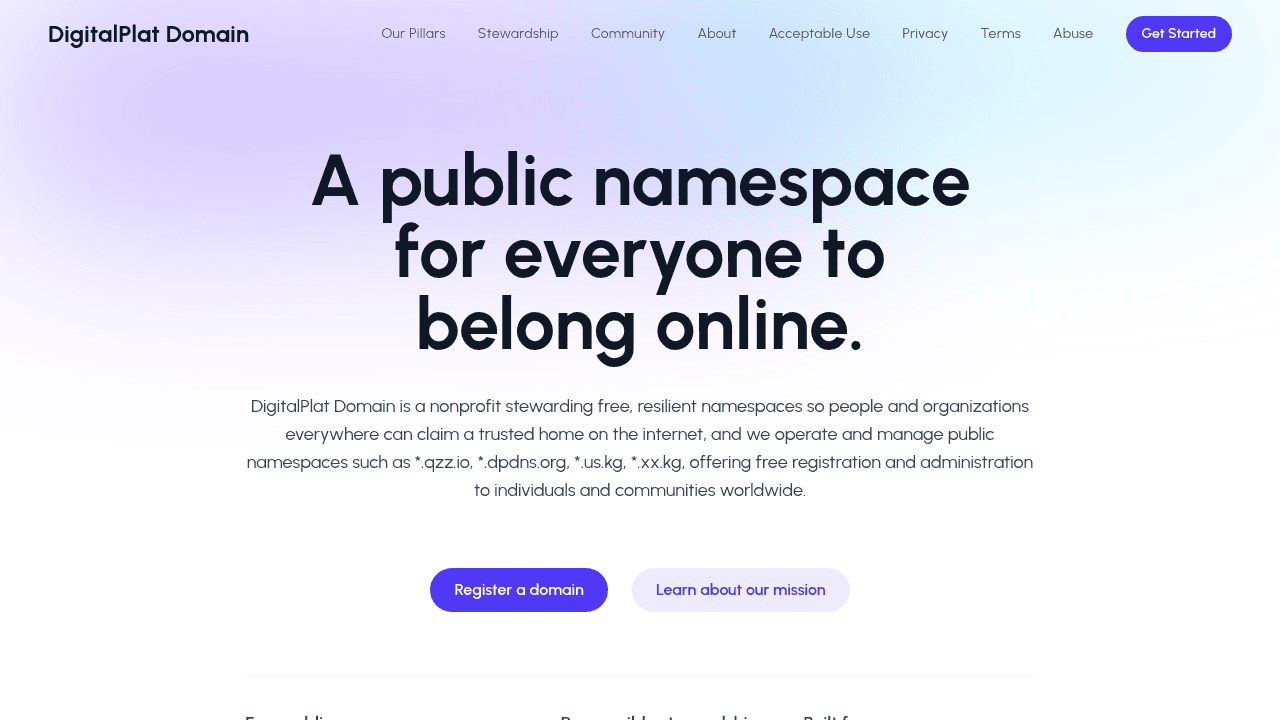
When Freenom shut down in 2024, millions of students, hobbyists, and developers in budget-constrained regions lost their primary way to get domains for first projects. A $10-15/year domain fee is nothing in Silicon Valley, but for a student in Southeast Asia or a developer prototyping in Latin America, it's the difference between building something and not starting at all.
Edward Hsing recognized that gap. At 15, he launched FreeDomain through DigitalPlat, a 501(c)(3) nonprofit he founded in 2022, creating one of the few community-governed alternatives to fill the void Freenom left.
What FreeDomain Offers
The infrastructure runs across 10+ global data centers serving 190+ countries—distributed DNS infrastructure operated under nonprofit stewardship. Users register domains through a web interface, select from available TLDs, and configure DNS records for personal projects, learning environments, or prototypes that don't justify commercial domain costs.
The operational model differs from traditional free domain providers: FreeDomain operates under published abuse reporting procedures and community governance, attempting to balance accessibility with accountability. It's an experiment in whether nonprofit stewardship can sustain free infrastructure without the commercial pressures that often compromise similar services.
How FreeDomain Fits Among Alternatives
FreeDomain enters a space with established players who've proven free domain services can endure. EU.org has operated since 1996—a 28-year track record. iFreeDomains has served 400,000+ users since 2012. These services represent the legacy that Freenom left behind when it was shut down by ICANN.
FreeDomain doesn't replace these options; it adds another tool with a different governance philosophy. Where EU.org emphasizes longevity and iFreeDomains focuses on scale, FreeDomain experiments with community-driven oversight. The nonprofit model means no venture capital pressures, no pivot to monetization—but also no guarantee of the resources commercial operators can marshal when infrastructure needs scaling.
Growing Pains: DNS Delays and Service Issues
Rapid scaling reveals technical debt quickly. GitHub discussions document what you'd expect from a young nonprofit handling growth: DNS propagation delays stretching beyond three days, account suspension issues requiring manual intervention, password reset failures, and Cloudflare CNAME configuration errors that block deployments.
These are the realities of operating free infrastructure at scale with limited resources. Commercial providers solve these problems by charging fees that fund 24/7 operations teams. Nonprofits solve them through community patience and iterative fixes. The GitHub discussions show both the problems and the maintainers working through them, which matters more than the absence of issues.
For developers who remember their own first projects running on free hosting and free domains, these tradeoffs feel familiar. The question isn't whether FreeDomain has service issues—it's whether those issues are disqualifying for your use case.
Who Should Consider FreeDomain
The service makes sense for specific scenarios: students building first portfolios, developers in regions where domain costs represent real financial barriers, educators running coding workshops who need quick domain provisioning, hobbyists prototyping ideas that might never see production traffic.
Set realistic expectations. This is young infrastructure operated by a nonprofit. DNS might take days, not minutes. Support happens through GitHub discussions, not enterprise SLAs. Features arrive when volunteer time allows, not when roadmaps demand.
But for learners who need a domain to make their project feel real, or developers in emerging economies who want to build without financial gatekeeping, FreeDomain offers what Freenom once did: a chance to start. The nonprofit model suggests that mission might persist beyond the commercial pressures that ended similar services—though only time will prove whether community governance can sustain free infrastructure long-term.
DigitalPlatDev/FreeDomain
DigitalPlat FreeDomain: Free Domain For Everyone