66K Stars: The Plugin That Ends Multi-LLM Setup Tax
Managing API keys, billing accounts, and rate limits across multiple LLM providers creates friction that slows development. dsh-our-free-model consolidates access to frontier models inside dsh without separate logins or per-token billing—but the transparency controversy around model routing and the "no usage cap" language deserves honest examination.
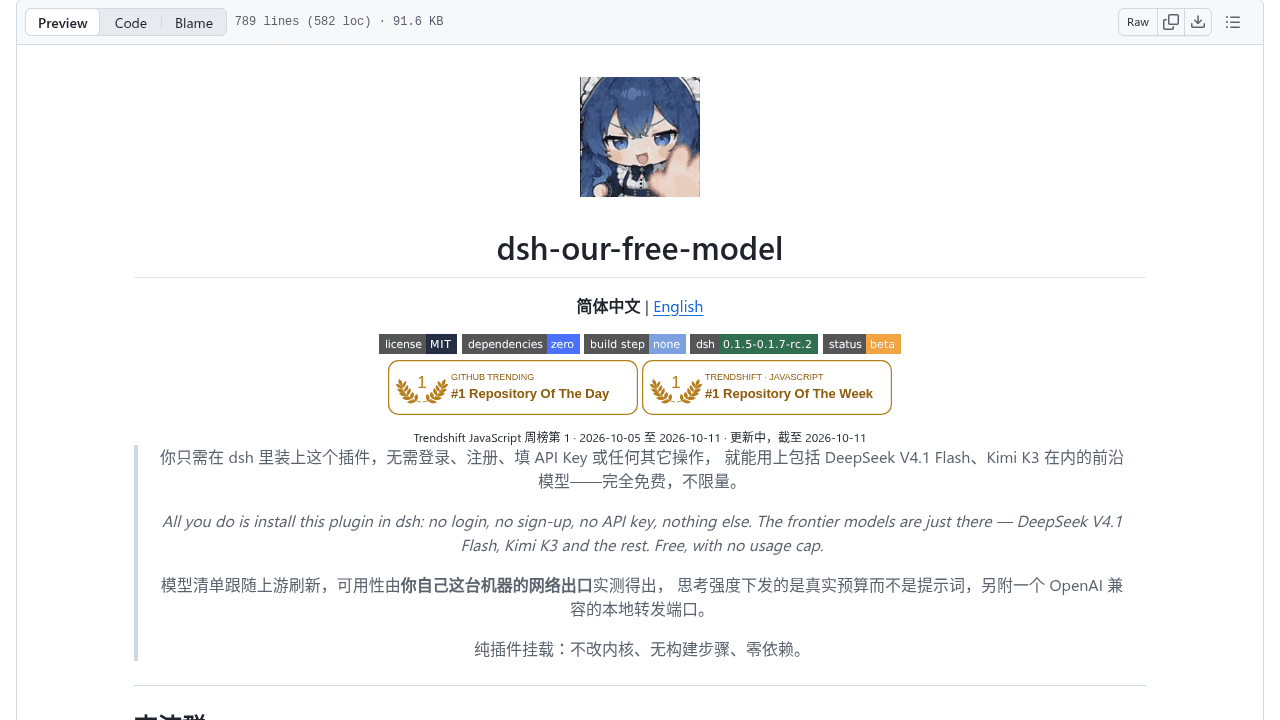
Every AI developer knows the ceremony: register with OpenAI, generate and store API keys, add Anthropic credentials, set up billing for Google's Gemini, track three separate rate limit policies, bookmark three documentation sites. Before writing a single line of application code, you're managing an authentication keychain and a mental map of which provider charges what per token.
The dsh-our-free-model plugin consolidates access to GPT-4, Claude, and Gemini inside dsh's interface without separate logins, API keys, or per-token billing configurations. Sixty-six thousand developers starred it, and it topped Trendshift's JavaScript rankings. It removes the setup tax.
The Setup Tax: Why Multi-Provider Development Feels Like Paperwork
Building with multiple frontier models means context-switching between provider ecosystems. Each has its own console, its own token counting rules, its own way of surfacing usage limits. Testing prompt performance across models requires keeping three browser tabs open, or writing wrapper code that abstracts provider differences—code that exists only to manage credentials and retry logic.
The cognitive overhead isn't the API calls themselves. It's the surrounding infrastructure: remembering which key corresponds to which project, tracking when you've burned through free-tier quotas, deciding whether to spin up separate billing accounts for client work. The actual model interaction is five lines of code; the plumbing around it is fifty.
One Plugin, Multiple Frontiers: How dsh-our-free-model Works
The plugin routes requests through gateway services—OpenCode and Kilo—that handle upstream authentication. Developers select a model in dsh's interface and send prompts without touching provider dashboards. The gateway architecture sits between dsh and the frontier labs, managing the credential ceremony invisibly.
"Free access" here means no payment setup required, not unlimited capacity. The OpenCode lane applies rate limits and can return HTTP 429 responses when capacity is exceeded—the same throttling you'd see hitting a provider's free tier directly. The difference is consolidation: one interface, multiple models, zero billing forms.
The Transparency Problem: Model Routing and Visibility
A Reddit review surfaced a concern: the default model picker didn't visibly identify which upstream service received prompts. The README documented the OpenCode and Kilo gateways, but the UI abstracted that detail away.
For developers sensitive to data routing—who need to know whether prompts touch OpenAI's infrastructure versus Anthropic's, for compliance or vendor trust reasons—this matters. Transparency about where requests land isn't just a nice-to-have; it's a prerequisite for informed consent. The documentation disclosed the architecture, but requiring users to read GitHub issues to understand routing is a gap between convenience and control.
"No Usage Cap" vs. Reality: Rate Limits Still Apply
Marketing language created confusion. "No usage cap" was accurate in one sense—there's no paid plan or balance requirement—but misleading in another. Developers expecting unlimited requests hit rate limits and wondered why. The phrase suggested infinite capacity when it meant zero billing friction.
The OpenCode gateway throttles requests like any shared infrastructure. Treating "no cap" as "no limit" sets wrong expectations. The value proposition isn't unlimited access; it's consolidated access without payment setup, within the boundaries of rate limiting that protects shared resources.
The Consolidation Landscape: Subscriptions vs. Gateways
The dsh-plugin-subscriptions approach differs: it uses existing ChatGPT, Claude, or Copilot subscriptions rather than routing through a gateway. dsh-openai-gateway exposes configured providers through a single OpenAI-compatible endpoint—useful when you need one API surface but already manage credentials directly.
These aren't competing solutions; they solve adjacent problems. Subscriptions work when you've already paid for premium access. The OpenAI-gateway pattern fits teams standardizing on one interface. dsh-our-free-model targets developers who want to experiment across models without credential juggling.
The Trade-Off: Convenience vs. Control
Consolidation makes sense for prototyping, model comparison, and indie projects where setup friction exceeds production requirements. Direct provider relationships matter when you need cost optimization, compliance guarantees, or custom rate limit negotiations—contexts where abstraction layers introduce risk.
The Ebony-Vinyl team built something useful: a tool that respects developer time by eliminating ceremony. The transparency questions are worth addressing, and the "no cap" language needs clarification, but the core insight holds. Reducing friction isn't just convenience; it's respecting the finite attention builders have for problems that aren't their actual product.
Ebony-Vinyl/dsh-our-free-model
在 dsh 里装上这个插件即可,无需登录、注册或填 API Key,就能使用包括 DeepSeek V4.1 Flash、Kimi K3 在内的前沿模型——完全免费,不限量。 All you do is install this plugin in dsh: no login, no sign-up, no API key — the frontier models are just there, DeepSeek V4.1 Flash and Kimi K3 among them. Completely free, with no usage cap.