Cloudflare Open-Sources Multi-Agent Security Audit Tool
Cloudflare open-sourced the multi-agent security workflow they use internally, complete with 13,841 production findings and transparent benchmark data showing 15× higher costs than single-agent reviews. The release includes their six-phase architecture designed to reduce false positives through adversarial validation and independent verification.
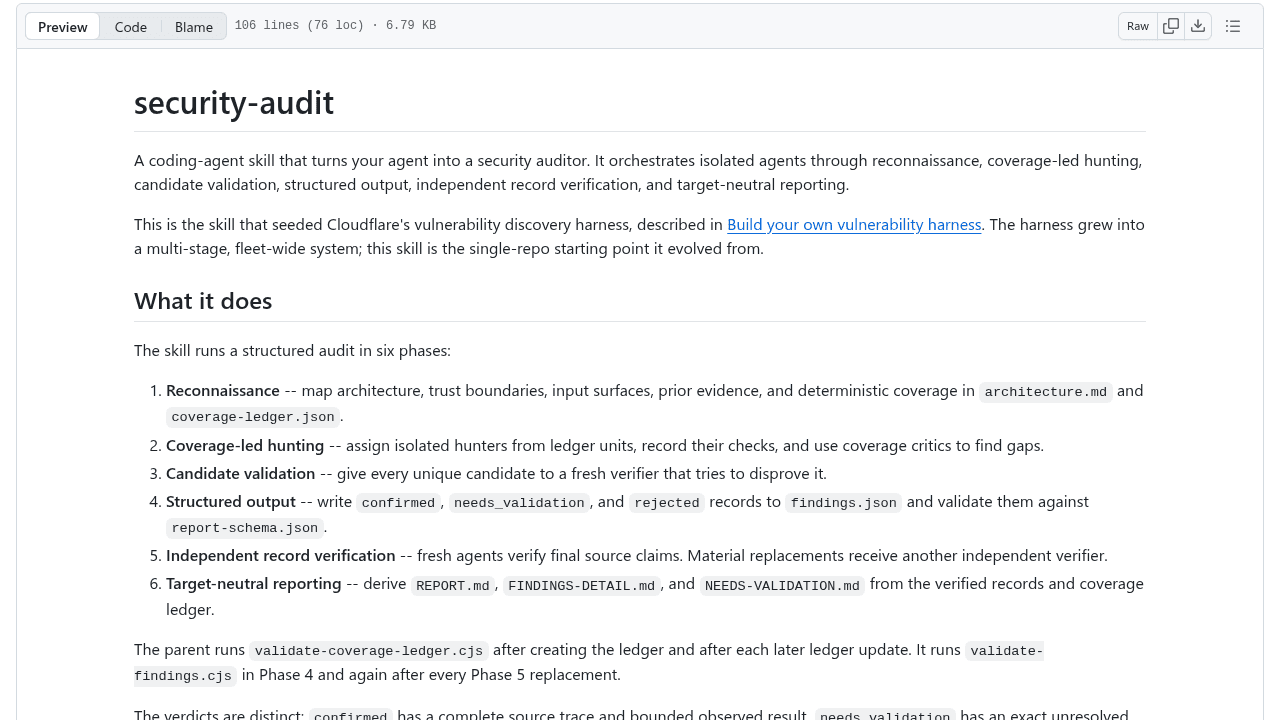
Cloudflare released the six-phase security workflow they built to audit code at scale, complete with production data showing 13,841 findings across 145 repositories—and the benchmark numbers that come with it. Security engineers now have a production-grade multi-agent system and real data about the economics of LLM-based code review.
What Cloudflare Released
The open-sourced workflow implements six distinct phases: reconnaissance, coverage-led hunting, candidate validation, structured output, independent record verification, and target-neutral reporting. This is the infrastructure Cloudflare uses internally to maintain their validation system of over thirteen thousand findings spanning 145 repositories.
The architecture reflects production needs at scale. Each phase hands off to the next with structured schemas, and findings must survive adversarial validation before being accepted. The system requires source traces, bounded observed results, and machine-readable output formats designed to minimize the false positives that plague traditional security tooling.
The Architecture: Multi-Agent by Design
Cloudflare chose multiple agents over single-agent reviews to address specific failure modes: single hypothesis bias, context window exhaustion after examining small portions of a repository, and information loss during context compaction. When a single agent tries to hold an entire codebase in memory, it either truncates aggressively or fixates on the first vulnerability pattern it spots.
The multi-phase approach splits those responsibilities. One agent scouts the terrain during reconnaissance, another hunts for coverage gaps, and a third agent verifies findings without knowing which agent discovered them. The separation tackles false positives through adversarial validation—findings must defend themselves to agents that didn't generate them.
The Benchmarks
Cloudflare shipped the performance data alongside the code. An independent benchmark reports the skill's quick profile costs a median of $29.95 per run compared to $2.06 for single-agent reviews. The recall on the tested target? Equal at 0.467 for both approaches.
That fifteen-fold cost difference without a recall improvement raises questions about when multi-agent workflows justify their expense. Cloudflare published it anyway. Security engineers now have real cost-benefit data from a company running this workflow in production, complete with the limitations still being worked through.
The Landscape: Agents vs. Rules
This release sits alongside mature SAST tools that take different approaches. Semgrep Code uses rules, data-flow analysis, and optional AI-powered detection of business-logic flaws. Snyk Code brings semantic analysis to repositories, IDEs, and CI/CD workflows while Snyk Open Source handles dependency vulnerabilities separately.
These aren't competing on the same axis. Rule-based static analysis optimizes for speed and determinism—you know exactly what patterns you're scanning for. Agent-based workflows attempt something different: exploratory analysis that adapts to each codebase's attack surface. The question isn't which philosophy wins but which problems each solves best.
Why This Matters
Major companies rarely open-source production security infrastructure with unvarnished performance data showing cost challenges. For teams evaluating LLM-based code analysis, the benchmarks provide grounding that vendor demos skip over. For researchers advancing agent-based security testing, it's a model of transparency—ship the system, share the limitations, let the community build on both.
Cloudflare could have waited until the economics improved or published only the success metrics. Instead, they gave security engineers the full picture: multi-agent architecture, real production scale, and the numbers about what it costs to run.
cloudflare/security-audit-skill
A coding-agent skill for multi-phase security audits with independently verified, machine-readable findings