Cut AI Agent Token Costs 99% With Graph-Based Memory
AI coding agents waste hundreds of thousands of tokens reading files to answer structural questions. A developer built codebase-memory-mcp, a Tree-sitter-powered knowledge graph that reduces token costs by 99%—though a Reddit A/B test reveals it's slower. We examine the trade-offs, real-world savings, and why 42+ contributors are betting on graph-based memory.
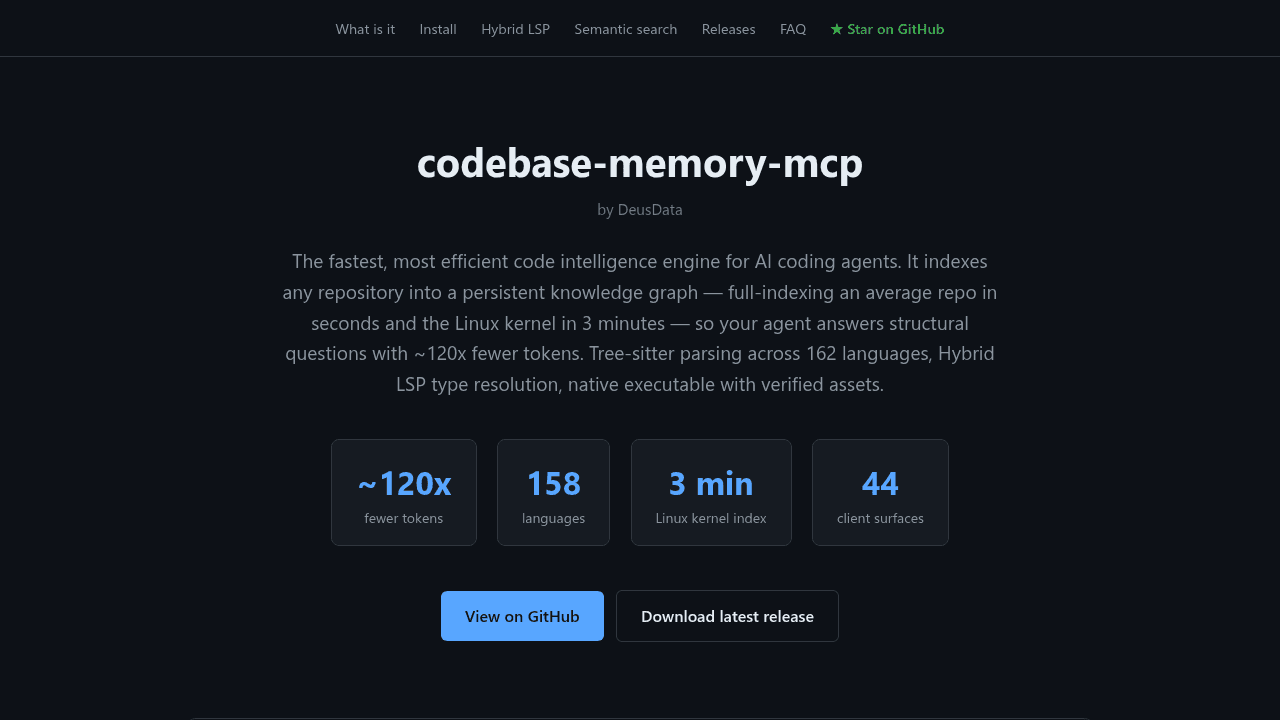
AI coding agents burn tokens the way teenagers burn through data plans—with alarming speed and no sense of consequences. Ask Claude or Cursor "where is this function called?" and watch it grep through your entire codebase, read dozens of files, and rack up hundreds of thousands of tokens doing work a simple index could handle instantly.
A Reddit user reported that codebase-memory-mcp replaced repeated file-by-file exploration with persistent graph queries, reducing five structural queries from approximately 412,000 tokens to approximately 3,400 tokens. For teams managing AI tooling budgets, that's not a rounding error—it's a different cost bracket.
The Token Bill Problem: When AI Agents Read Everything
The issue isn't that AI agents are inefficient; it's that they have goldfish memory. Every time you ask about call chains, dependency flows, or impact analysis, the agent starts from scratch. The project addresses the token and tool-call cost of agents repeatedly reading files and using grep to answer structural questions that a knowledge graph could resolve in milliseconds.
One Hacker News commenter identified using codebase-memory-mcp as one of the largest cost-reduction improvements in their workflow. If you're doing the same architectural queries repeatedly, paying full token price each time is leaving money on the table.
How Graph-Based Memory Works: Tree-sitter, SQLite, and MCP
The server parses source with Tree-sitter, stores functions, classes, imports, calls, routes, and other relationships in SQLite, and exposes structural queries through the Model Context Protocol. Instead of reading files linearly to discover what calls what, the graph answers relationship questions with SQL queries.
Why does this matter? Because "find all callers of function X" is a graph traversal problem disguised as a text search. Tree-sitter gives you the AST, SQLite gives you relational storage, and MCP gives agents a standard way to ask questions. The result is a persistent memory layer that survives across sessions.
The Trade-Off: 40% Slower Execution in A/B Testing
Token savings this dramatic deserve scrutiny, and a Reddit A/B test on a production TypeScript monorepo provided it: functionally equivalent results between graph-based and plain-text exploration, but the graph-based agent took approximately 40% longer.
That execution penalty isn't trivial. Graph setup overhead, query planning, and the coordination daemon all add latency. For teams optimizing purely for speed, plain-text tools may still win. But for developers watching token meters spin like taxi fare counters, trading time for cost is a reasonable play—especially when the functional output remains identical.
Where It Fits: A Maturing Category
The main comparable MCP code-intelligence tools are @ttsc/graph, codegraph, and Serena. codebase-memory-mcp differs by combining a relation graph, an openCypher query subset, broad multi-language Tree-sitter coverage, and graph-based architecture and impact queries. Each tool makes different trade-offs; this one bets on query expressiveness and multi-language support.
The MCP space benefits when multiple tools explore the same problem space with different approaches. Developers win when they can choose the tool that matches their priorities.
Momentum: 781 Commits, 42 Contributors, and Regular Releases
The v0.10.0 release introduced a shared coordination daemon, compact output, coverage reporting, language support additions, and installer support for 43 coding-agent surfaces. The release notes report 781 commits, 183 merged pull requests, 42 contributors, and more than 40 community-reported issues fixed since v0.9.0.
The v0.11.0 release brought 171 pull requests—76 from external contributors—and fixes for large-repository memory usage, installation reliability, daemon startup, and indexing performance. That's the velocity of a project finding real adoption.
When Graph Memory Makes Sense (and When It Doesn't)
If you run frequent structural queries, work in large codebases, or manage token budgets across a team, graph memory pays for itself quickly. The 99% token reduction is real, and the execution penalty may not matter if you're optimizing for cost over speed.
If you prioritize execution speed or do mostly exploratory work without repeated architectural queries, plain-text tools remain competitive. This is a tool with clear use cases, not a silver bullet. The honest A/B test data and transparent trade-offs make the choice easier: measure your own workload, then decide whether you're paying for speed or for tokens.
DeusData/codebase-memory-mcp
High-performance code intelligence MCP server. Indexes codebases into a persistent knowledge graph — average repo in milliseconds. 158 languages, sub-ms queries, 99% fewer tokens. Single static binary, zero dependencies.